

HEINER GOEBBELS’ ORACLE MACHINE MUMBAI
by Vinta Nanda March 16 2026, 12:00 am Estimated Reading Time: 4 mins, 6 secsAt Great Eastern Mills in Mumbai, German composer and artist Heiner Goebbels unveiled The Oracle Machine, a mesmerizing installation of light, sound and archival voices, hosted by the German Consulate General Mumbai for an unforgettable cultural evening. Vinta Nanda reports…
On a soft Mumbai evening, within the industrial poetry of the old mill compound at Great Eastern Mills, art unfolded in a way that felt both ancient and futuristic. The occasion was the unveiling of The Oracle Machine, an immersive installation by the celebrated German composer and artist Heiner Goebbels, hosted by the Consul General of Germany in Mumbai, Christoph Hallier, and his wife Sybille Bühre.
The venue could not have been more apt. The skeletal architecture of the mill—industrial, historical, and open to the night sky—became the perfect stage for a work that itself draws from the echoes of time. The installation formed part of Goebbels’ exhibition Landscape Plays, his first solo exhibition in India, which explores the intersection of sound, visual art, and performance through immersive, site-specific installations.
At the heart of the evening was The Oracle Machine, a sculptural installation resembling a temple-like construct. Using light, sound, reflections and shadows, the structure transformed into a living organism of voices and memories. Archival recordings—voices drawn from different countries and different historical moments—emerged and dissolved through the space, making the structure feel almost prophetic, like a contemporary oracle speaking through fragments of the past.
Asking the Artist
I had the opportunity to ask Goebbels two questions as he revealed the installation. My first question was about the collaborative nature of his work.
“You talk about the collaborative process — building compositions of things you haven’t created…”
Goebbels smiled, slightly hesitant. “You are asking me about a lifetime of work,” he said gently, suggesting that the answer could hardly be compressed into a few minutes. Yet he offered something profound.
His work, he explained, is a confluence of elements created by many artists across time. What he does is bring these elements together. “I mistrust my ideas,” he said candidly. “I think it is the treasure of works from the past, the expressions of artists over the years, that validates my ideas. The voices of the past are so much richer than what one person can imagine in the present all by himself.”
For The Oracle Machine, he worked with archival recordings—voices from different countries and eras, including songs recorded by prisoners in camps during the First World War in Germany. Listening closely to those voices, he tried to understand what they were conveying and reinterpret them as messages for the present.
The second question I asked him came from something he often says about the importance of not fully understanding art.
If not understanding a piece of art frees imagination, then what should a viewer do when encountering something they do not understand?
His answer was beautifully nuanced. “It’s a little different,” he said. “I do understand what I’m doing. But I am open to listening to how others interpret my work. That expands my own understanding of my work.”
The Audience and the Experience
As the roughly thirty-minute performance unfolded in the open air, most of the guests stood utterly still, enthralled by the slow transformation of sound and light across the structure. The voices seemed to float across the night sky, while shadows rippled across the surfaces like moving memories.
Yet, inevitably, is not necessary for you to understand art. What matters is your experience of it. As Goebbels himself suggests, interpretation belongs to the viewer. But interpretation requires presence. It requires silence. It requires the humility to allow something unfamiliar to happen to you.

A Gathering of Friends
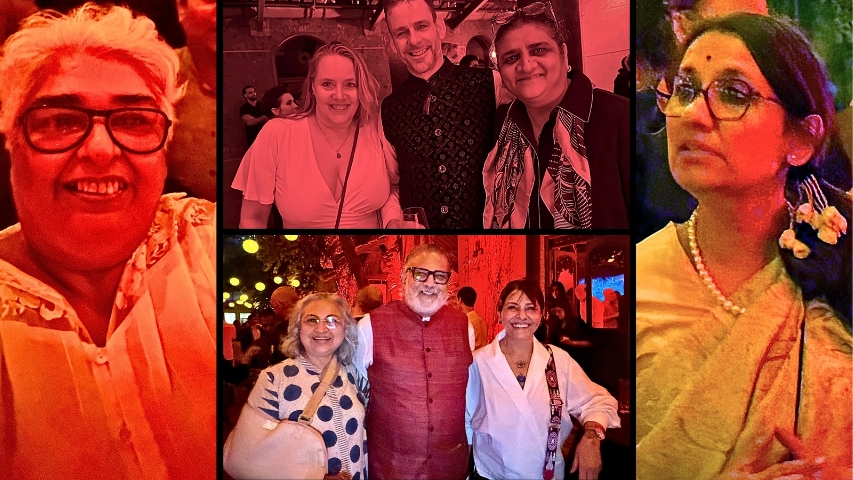
The evening was also a rare opportunity to meet friends and fellow artists in a setting that felt intimate despite the large guest list. Among those present were filmmaker Leena Yadav, cinematographer Aseem Bajaj, Gauri Mehta, Rukmini Dahanukar, Dhanashree and Dhananjay Hardas and Tushar Gandhi with his wife Saloni. Seeing them there added to the warmth of the evening.
A Rare Cultural Gift
What the Consul General Christoph Hallier and his wife Sybille Bühre brought together last night was more than an art event. It was an experience many of us might never otherwise have encountered in Mumbai — a meeting point of sound art, history, memory and architecture. And the choice of venue — the quiet majesty of The Great Eastern Mills — was nothing short of perfect.
For those thirty minutes, the past spoke through voices carried across time, and the city paused just long enough to listen.
Trending Now, What Everyone Is Talking About, Cultural Moment, Social Pulse, In The Spotlight, Internet Reacts, Current Conversations, This Moment Matters, Now Streaming In Public Discourse,





-173X130.jpg)
-173X130.jpg)
-173X130.jpg)